Lately, I've been shifting more towards Sony equipment for my video work, and there are a few key reasons behind that decision. Let's talk about it in this article!
 |
| A close up of the video rig. |
I initially tried using the Nikon Z30 as a replacement for my Canon EF-M equipment I sold a while back. While I knew of users saying the Z30 can overheat, I wanted to test that for myself so I gave the camera a chance.
Unfortunately, it consistently overheated after about 25 minutes outputting 4k through HDMI. That's with no internal recording and a DC coupler instead of a battery. The Canon M6 Mark II camera had no issue outputting 4k through HDMI, but would overheat doing internal recording, so I thought the Z30 might be similar. Sadly that's not the case.
 |
| The Sony ZV-E10 with the Atomos Ninja V. |
It's a problem when I'm filming longer videos, like detailed lighting equipment reviews that can take an hour or two. Or filming multiple hands-on equipment videos. So I've been looking for a camera that could keep running without issues. I've got the original A7S which has been capable in my testing so far outputting 4k through HDMI without overheating, but it has contrast based autofocus.
The Sony ZV-E10 as a replacement for the Nikon camera.
So, I swapped the Z30 for the Sony ZV-E10 when I did a big trade-in with MPB. So far, it's been performing much better, handling 4K output for as long as I've needed it. I've been shooting in 30 frames per second mode, which does have a crop. It's not ideal, and I wish I could have gone for the newer more expensive model, but it isn't feasible given my current viewership. The ZV-E10 will likely be my main video camera for a while, and I'll also use it for photos and other tasks for the sake of content. Another goal was to have a few different mounts on-hand in case companies wanted to send me lenses to look at.
 |
| The video rig is blending into my video. I should have boosted it, lol. |
I'm also using the Atomos Ninja V. I have the paid add-on pack for HEVC encoding. The newer models might include that feature as standard. This allows me to record in a very efficient 4k 8-bit 4:2:0 codec, which saves space and simplifies my workflow, since I often don't need to do extensive adjustments to my videos. Saving space helps with project backup costs, and having a camera that won't overheat on me in a studio situation is super important (I'm not saying at this point the ZV-E10 won't, but so far so good).
I also needed another AC adapter, so I picked up another F1TP AC adapter for the older Sony battery type (NP-FW50). This isn't my first one from them. They sent me one early on, but I've purchased a couple myself since then. They've been consistently reliable. There's always some sort of risk with third-party adapters, but I've never had one damage a camera. Just remember to use them at your own risk.
 |
| The contents of the AC adapter box. |
It comes in a simple box, with a standard power cable, the AC adapter itself, hook-and-loop ties, and the DC coupler. It's a very straightforward setup. You connect the breakout cable with the DC coupler to the AC adapter, plug in the power cable to the AC adapter, and you're good to go once you insert the DC coupler into the camera.
 |
| A closer look at the F1TP Power Supply AC adapter. |
The specification is that it has class 2 power supply. It outputs 7.6 volts at 2 amps.
 |
| Putting the DC coupler into the ZV-E10 camera. |
There's a rubber flap on the back of the battery door that you need to loosen (don't pull it off completely!), route the cable through the opening, and then lock the battery door in.
For lenses, I've been moving towards zoom lenses. I'm using the Sigma 18-50mm f/2.8 APS-C lens on my a6000 that I use as my computer webcam at 1080p. The lens aperture is a benefit, but that lens has some clear distortion at the wide end. For the capture device I use an AVMATRIX UC1218 USB capture device.
 |
| The Sigma 18-50mm f/2.8 lens for Sony E-mount. |
I'll be using the Sony E 16-70mm f/4 OSS lens with the Sony ZV-E10 most of the time. It's been consistent and actually has less distortion than the Sigma, which is nice. The downside is that it's f/4 maximum aperture instead of f/2.8, but it works well enough. It also has optical stabilization in case I want to do vlogging.
 |
| The Sony E 16-70mm f/4 OSS lens. |
On the Sony A7S, I have the Sony 24-70mm f/4 OSS, which was the most affordable decent looking autofocus Sony lens I could find. I mostly use manual focus with that setup, as the A7S has contrast-based autofocus, which isn't ideal for continuous autofocus. I use it because it's affordable and outputs 4K. Though I'm currently outputting 1080P to the capture card, but it's capable of outputting 4k 30 fps. I could use this on my video rig when autofocus isn't necessary.
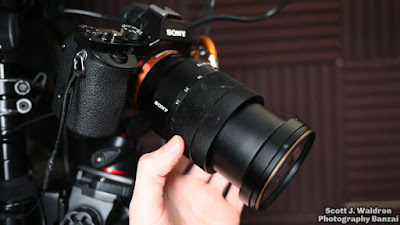 |
| The Sony FE 24-70mm f/4 OSS lens. |
Looking ahead, I'd like to be fully capable of 4K. Ideally, I'd love to upgrade to the FX30 or FX3 cameras in the future, or maybe the Panasonic S5ii or S5ii X. But all of those are expensive to me.
For now, I will move to the Sony cameras for video. An added bonus is that there is less HDMI lag compared to some Nikon cameras I have used. I'm keeping my Nikon Z5 for photography as well as some video when needed.
This setup should give me more flexibility for hands-on videos and reduce any concerns about overheating. It's a step in the right direction as I continue to refine my video production process.
Look at some of the equipment used...
F1TP NP-FW50 DC Coupler AC Adapter Kits:
The Sony ZV-E10 Camera:
Sigma 18-50mm F2.8 DC DN for Sony:
- B&H: https://bhpho.to/4cv83gk
- Amazon: https://amzn.to/46Y5en1
As an affiliate of these shops, I earn from qualifying purchases! What I link isn't important, but rather the time from click, which tends to be 24 hours with shops like Amazon.
Check out the video on YouTube going into more detail and with more visuals than the website article: