The original Nikon Z50 was released in 2019. What does the Nikon Z50 II offer compared to the original after 5 years? Let's take a look!
 |
| The Z50 II with a kit lens. |
I haven't used the Z50 II camera. This is mostly a dive into specifications. I have tried the original Z50. Even back then it felt a bit quirky in some aspects, but overall a decent camera.
A few references:
- https://www.nikonusa.com/p/z50ii/1784/overview
- https://imaging.nikon.com/imaging/lineup/mirrorless/z50_2/
- https://www.dpreview.com/reviews/nikon-z50ii-initial-review
- Petapixel: https://www.youtube.com/watch?v=D5Qm_RPoQxg
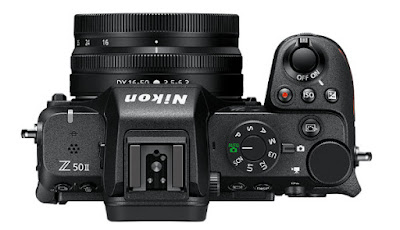 |
| The top of the camera. Notice the button below ISO. That's for picture control. |
The good (most of these copied from Nikon's global website):
- Fully articulating screen similar to what is on the Z30 and Zfc.
- Tally light on the front of the camera.
- Pop-up flash for people that want it.
- The EN-EL25a battery was slightly upgraded.
- Autofocus improvements with 9 different subject types inherited from the Z9 and Z8.
- 1.0-cm/0.39-in., 2.3M dot (XGA) OLED electronic viewfinder.
- Pre-Release Capture at up to 30 fps allows capture up to 1 second before fully pressing the shutter release button.
- Video recoding options like 5.6K oversampled to 4K 10-bit H.265 N-Log. In addition to full HD/120p in 10-bit H.265.
- Video features including Hi-Res Zoom, and N-Log/HLG support, and waveforms.
- Enhanced camera responsiveness in Auto shooting mode from Nikon's "unique AI deep learning technology".
- Seamless switching between portrait and landscape shooting with an adaptive vertical UI display for stills.
- Nikon Imaging Cloud enables image transfer without the need for a computer and offers download of Imaging Recipes.
- The memory card slot was updated to UHS-II.
The Nikon:
- A dedicated button for one-touch access to Imaging Recipes and Picture Controls. Are people really using the old picture controls: Denim, Toy, Sepia, Blue, Red, Pink, Charcoal, Graphite, Binary, Carbon and such? They should get rid of those considering they should be able to be mimicked with the new recipe feature.
- Nikon Z cameras all have generally nice build quality. Even the Z30 which tends to be the cheapest Z camera at the moment.
- Full separation of photography and video with a toggle switch.
- On screen information changes with physical orientation of the camera.
- It looks like they stopped including a charger. From the global website: EN-EL25a Rechargeable Li-ion Battery, AN-DC29 Strap, UC-E25 USB Cable, BF-N1 Body Cap.
- Somewhat open yet still restricted Z mount in regard to native autofocus lenses. At least Sigma has offered a few APS-C lenses. Oddly enough Nikon seem more open about APS-C than full-frame, which benefits the Z50 II.
 |
| The fully articulating screen like the Nikon Z30 and Zfc have. |
The not so good:
- Likely the same sensor and related readout performance as the original Z50. They are also oversampling from 5.6k for video now, which likely increases rolling shutter issues. But you will get more detail. Pure speculation on my part without out any data to back it up.
- No internal sensor based stabilization.
- 1/4000th of a second maximum mechanical shutter speed.
- EN-EL25 series battery. I don't know why camera companies insist on having a separate battery for their lower-end cameras. The should use the larger battery in all of their cameras that are not compacts.
- One memory card slot.
- Lower resolution 2.36M dot EVF that looks physically small.
- Not much cheaper than the Nikon Z5 as it's often available for around $1000.
- 4k 60fps has large a crop. Considering the processing improvements, this is probably due to the sensor itself.
My opinion on the camera and its features:
The viewfinder eye relief was reduced. For people with large noses this looks like a downgrade. Overall the viewfinder on the camera seems low-end compared to a camera like the Z5.
The state of APS-C cameras isn't great in general. Sony only started refreshing their lineup with a faster read-out 26 MP sensor where the cheapest one is the ZV-E10 II that is video focused.
The 24 MP sensor used in cameras like the Sony a6100, a6400, and ZV-E10 is worse than the sensor in the Nikon.
Canon also had a fair amount of APS-C bodies at this point. The R50 is under $700 and covers a lot of what the Nikon does.
I'm not knowledgeable about Fujifilm, but I'm going to assume they have a ton of options available. On B&H it looks like the cheapest new camera is the X-M5 right now at $800 which is prerelease. They also have the X-T30 II very close in price to the Z50 II.
It's going to be a fine camera for Nikon, but there is a lot of competition and I'm doubtful it's going to be a camera that will motivate a lot of people to consider Nikon. With a camera like the Z5 they managed to have a good mix of features like dual card slots and a good viewfinder comparatively to other manufacturers. For the Z50 II I'm not sure it's as strong of a deal. Had they done something like integrate IBIS into the camera for $1000, I think it would have been a hot seller.
Check out the camera through my affiliate links:
- B&H Photo Video: https://bhpho.to/4es6jFP
- Amazon: https://amzn.to/48M6uud