With the advent of mirrorless cameras, there was a shift in registration distance for lenses. That opened possibilities to use existing lenses on these newer mounts.
 |
| Various lens adapters. |
The official Canon EF-EOS M adapter:
B&H Photo Video, Amazon, Used on KEH, and eBay.
Metabones Speed Booster 0.71x Adapter for Canon EF to EF-M Mount:
B&H Photo Video and Amazon
Viltrox EF-EOS M2 Speed Booster 0.71x Lens Adapter:
Amazon, eBay, B&H Photo Video, and used on KEH.
As an affiliate of these shops, I earn from qualifying purchases!
This is all about flange focal distance. It’s the distance from the lens mount ring to the sensor or film plane. https://en.wikipedia.org/wiki/Flange_focal_distance
Older camera systems have a long distance. Newer camera systems have a short distance. So that means with something between an old lens and a new mount you can make the combination work.
The distance is measured in millimeters.
A few examples:
- Canon FD: 42mm
- Canon EF: 44mm
- Canon EF-M: 18mm
- Nikon F: 46.5mm
- Nikon Z: 16mm
- M42: 45.46mm
- L39: 28.8mm
 |
| The 30D next to the M50. You can see the difference inside the sensor area. |
A little test you can do is holding a lens like the EF 50mm in front of the M50 camera without a lens. Moving it back and forth shows where that registration distance is… the same as the thickness of the adapter.
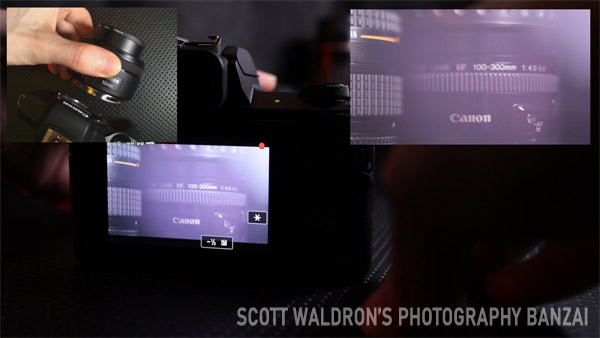
The details of adapters are not so simple.
Let’s talk about some of the adapter types…
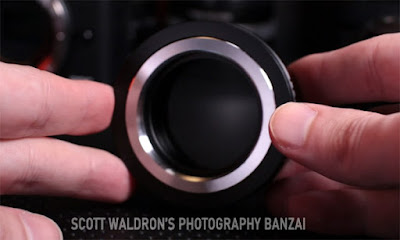 |
| It’s a metal tube with the proper connections. |
The cheapest and most common have no control through the camera or any levers.
- Cheapest more available type.
- The simplest option for old film era lenses because you don’t need anything more.
- If your lens doesn’t have a manual aperture then you will not be able to adjust it. This is the case for Canon EF lenses. You can see the two that I have would not work with a basic adapter.
 |
| This Nikon-F to Canon EF-M adapter has a mechanical ring for Nikon lenses that have a mechanical aperture. |
There are adapters that have a mechanical way to control aperture. This depends on the lens being adapted. Only certain ones have mechanical properties to them that allow this type to work.
- Some older lenses had a physical lever for controlling aperture. In my case I have a Nikon F-mount lens with the lever and an M42 lens with something similar.
- The adapter I have for F-mount does physically adjust the adapter, but it is imprecise with no way to set a specific value.
 |
| The official Nikon F to Z adapter has full control with some lenses, but the d-type lenses without a motor inside can’t autofocus. |
Some control through the camera.
- There are adapters that allow for some level of control.
- For example, the official Nikon F to Z mount adapter can control aperture, but does not have a motor for autofocus with D-type lenses.
- These are better than basic adapters when you need some level of control through the camera.
- There are other adapters that have quirks or limitations like not being able to do a special focusing mode that a native lens would be able to do.
 |
| Canon EF lenses have a more technological design, so nothing special is needed with the adapter to allow for full control from RF and EF-M. |
Adapters with full control through the camera.
- These adapters allow for the same amount of lens control compared to a native lens usually.
- The official Canon EF lens adapters for EF-M and the RF mount have full control.
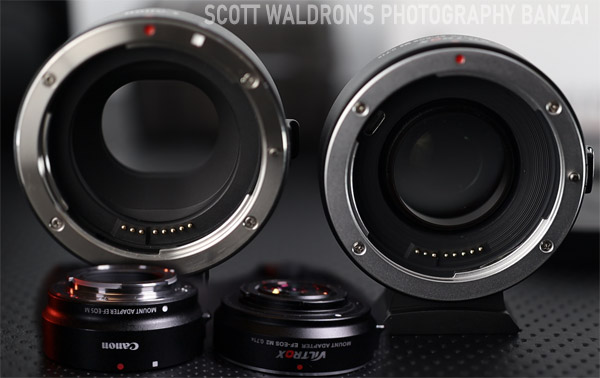 |
| The Viltrox speedbooster next to the official Can EF EOS M adapter. |
Speedbooster adapters (focal reducer)
- https://en.wikipedia.org/wiki/Telecompressor
- These adapters take lenses meant for a larger format such as Full-Frame but focus the light into the area of a smaller format like APS-C.
- It reduces focal length and increases lens speed.
- You can see that my Viltrox 0.71x speedbooster is physically shorter than the standard adapter and it has optical glass inside.
- Most of these adapters are fully electronic and work with a specific lens and mount combination.
- These tend to be some of the most expensive types of adapters.
- Expect overall image quality to depend on the optics of the speedbooster.
Other more obscure adapters
- The company Fotodiox has a large number of specialty adapters from tilt/shift to internal iris and auto focusing.
- Canon’s official EF to RF adapter with a built-in variable ND filter or circular polarizer. Their adapters also allow for a custom control ring.
I hope that helped you understand what lens adapters for mirrorless lens adapters do. Having a change in flange focal distance allowed for a lot of inventive adapters to be created. It’s a reason to hold on to your older lenses and a reason to pick up a mirrorless camera if you haven’t yet.